
Building Websites Housing Organizations Can Actually Run

Your website is the front door to housing
If you run a housing authority or a housing services organization, your website isn’t a brochure. It’s the front door. Someone looking for a place to live, a caseworker checking eligibility, a board member reviewing a report, a donor deciding whether to give: they all start with your site. And increasingly, they all need it to work the way they expect, on the device they’re holding, regardless of how they navigate the web.
That last point isn’t optional anymore. Under the Department of Justice’s updated ADA Title II rule, public entities have firm deadlines to meet WCAG 2.1 AA. Housing authorities sit squarely inside that requirement, and a site that can’t be used with a screen reader, or that fails on contrast and keyboard navigation, isn’t just a usability problem now. It’s a compliance exposure.
When does my housing authority have to be ADA-compliant?
| Public entity size | Compliance deadline | Standard |
|---|---|---|
| Serving 50,000 or more people | April 26, 2027 | WCAG 2.1 AA |
| Serving fewer than 50,000 people | April 26, 2028 | WCAG 2.1 AA |
| Special district governments | April 26, 2028 | WCAG 2.1 AA |
We’ve spent 29 years building for mission-driven organizations, and housing providers are some of the clients we understand best. Here’s how we approach the work, told through four organizations whose sites had to do real work for real people.
Five housing organizations we’ve built for
Not every site needs the same thing. Here’s the short version before we get into each one.
| Organization | The problem | What we did | The takeaway for housing authorities |
|---|---|---|---|
| Beacon Interfaith Housing Collaborative | Dated design, unclear hierarchy, weak path to action | WordPress rebuild, contrast fixes, prioritized CTAs, mission-forward homepage | Your most important pages must be the clearest and most accessible |
| Minnesota Habitat for Humanity | Poor location-mapping, fragmented access, clunky CMS | Redesign with cleaner navigation, better mapping, faster performance, easier backend | Resident-facing search and mapping are worth getting right |
| Simpson Housing Services | Outdated, no mobile support, accessibility gaps, heavy content | Mobile-first rebuild, accessibility baked in, storytelling photography | Build sites that survive staff turnover |
| The Doe Fund | Outdated and hard to manage, but design worth keeping | Targeted accessibility fixes, Kadence migration, PHP update, staff training | A full rebuild isn’t always the answer |
| Ventura Housing | Brand and site needed to be ready before a fixed community event | Strategic rebrand and accessible WordPress redesign on an emergency timeline | Accessible work can still hit a hard deadline |
Clear calls to action: Beacon Interfaith Housing Collaborative
Beacon came to us with a site that was holding the mission back. The design was dated, the visual hierarchy was unclear, and the path to take action, including donating, was hard to follow. None of that serves someone who arrives with a specific need and a limited amount of patience.
We rebuilt the site in WordPress with a mission-forward homepage, fixed the contrast issues that were creating accessibility barriers, and prioritized the calls to action so the most important next step was always the obvious one. The result is a site that’s easier to use, clearer to read, and far better at moving someone from “I’m interested” to “I’ve acted.”
For a housing authority, the parallel is direct. Your most important pages aren’t your news feed. They’re “find housing,” “apply,” and “check my status.” Those have to be the clearest, most accessible things on the site.

Resident-facing search and mapping: Minnesota Habitat for Humanity
Minnesota Habitat had a specific, practical problem: their ReStore locations were hard to find. The map experience was poor, store access was fragmented, and the team had inherited a clunky CMS that made everything harder to maintain.
We redesigned the site in WordPress with cleaner navigation, a better location-mapping experience, and performance work so pages loaded faster. Just as important, we cleaned up the backend so internal staff could actually manage the site without a developer on call.
Housing authorities run into the same thing constantly. Property lookups, location-based search, “what’s available near me”: these are exactly the resident-facing tools that frustrate people when they’re built poorly. They’re solvable, and they’re worth getting right.

A site that survives staff turnover: Simpson Housing Services
Simpson’s site had aged out. The design was outdated, there was no real mobile support, accessibility gaps had crept in, and the content had grown heavy and hard to navigate.
We rebuilt it mobile-first, with accessibility baked in and storytelling photography that puts the people Simpson serves at the center. What we’re proudest of is the longevity: we relaunched Simpson’s site in 2016, again in 2022, and we’ve continued to support their work over the years. That’s the kind of relationship that matters when your communications team turns over but your mission doesn’t.
Housing authorities know this problem well. Staff change, priorities shift, and a site that depends on one person’s institutional knowledge becomes a liability. We build sites that survive the people who launched them.

Accessibility remediation without a full rebuild: The Doe Fund
Not every project should be a teardown, and we’ll tell you when it shouldn’t be. The Doe Fund had an outdated WordPress site that wasn’t fully accessible and was difficult to manage. We proposed a full redesign. The team preferred to keep the visual design they knew and focus the budget where it mattered most.
So that’s what we did. We migrated the site into Kadence block-based editing, fixed the accessibility issues that mattered most (navigation contrast, heading structure, zoom responsiveness), updated the PHP environment, and trained their staff to structure content properly going forward. The site is now more accessible, easier for their team to manage, and the critical WCAG issues are addressed, all while keeping the look the team was comfortable with.
For a housing authority working against a fixed budget and a compliance deadline, this is often the smartest path. You don’t always need to start over. Sometimes you need a partner who’ll tell you honestly where the real risk is and fix that first.

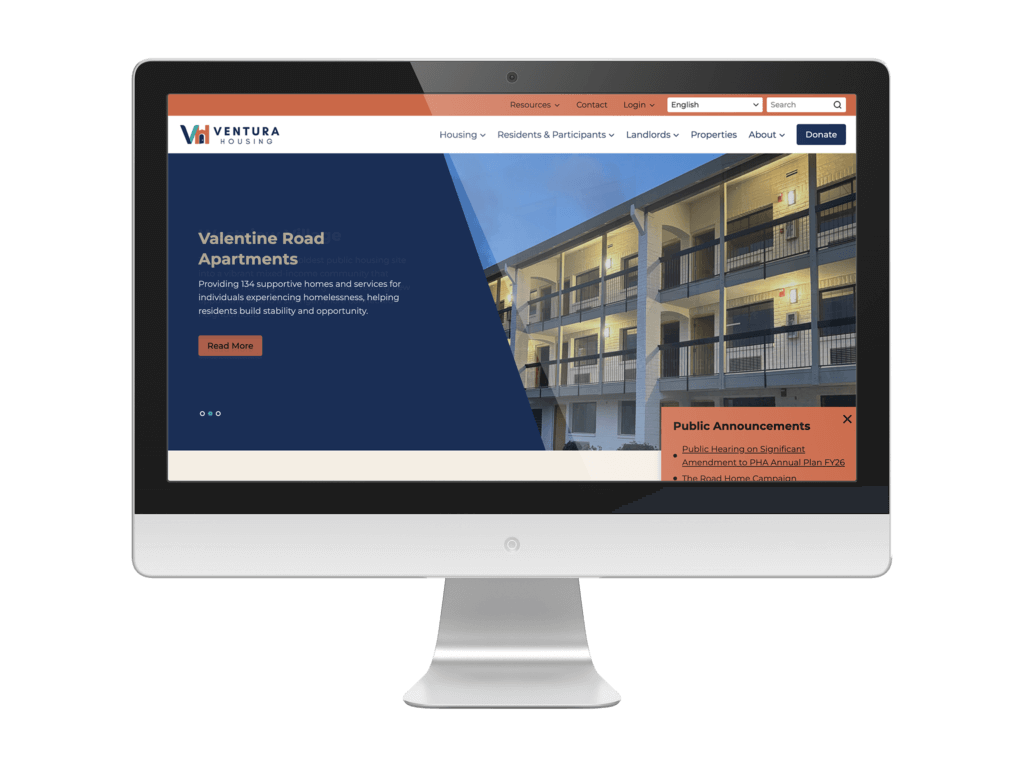
Accessible work on a hard deadline: Ventura Housing
Sometimes the calendar isn’t negotiable. Ventura Housing needed both a refreshed brand and a new website ready in time for a community event in October, which meant the work had to move on an emergency timeline without cutting the corners that matter.
We delivered a strategic rebrand and an accessible WordPress redesign, and we launched it before the event. The point worth sitting with: accessibility and a tight deadline aren’t opposing forces. When accessibility is built into how the site is made rather than bolted on at the end, it doesn’t become the thing that slows you down.
For a housing authority, that’s the reassuring version of the ADA Title II story. A deadline doesn’t mean accessibility has to slip. It means you want a partner who builds accessibly by default, so a fixed date and a conformant site can both be true.
Should you rebuild your site or remediate it?
The Doe Fund question comes up constantly: do we start over or fix what we have? Here’s how we help clients decide.
| Lean toward remediation when… | Lean toward a full rebuild when… |
|---|---|
| The visual design still works and the team likes it | The design is dated and off-brand |
| The site is on WordPress and structurally sound | The site is on an unsupported or hard-to-manage platform |
| Accessibility issues are fixable in place | Accessibility problems are baked into the architecture |
| Budget is tight and the deadline is close | You’re due for a refresh anyway and have runway |
| Content and structure are mostly right | Navigation and content need to be rethought |
There’s no universal right answer. The point is to put your budget where the actual risk is, and a good partner will tell you honestly which side you’re on.

What housing authorities should prioritize now
The thread running through all four projects is the same one that runs through good housing work generally: meet people where they are, remove the barriers, and build something the team can actually sustain.
For housing authorities specifically, that means three things right now:
Accessibility isn’t a feature you add later. With ADA Title II deadlines approaching, WCAG conformance has to be part of how the site is built, not a patch applied at the end. We’ve been doing accessibility-first development for years, and we monitor sites for ongoing conformance after launch so you don’t drift back out of compliance.
Resident-facing tools have to actually work. Search, mapping, applications, and status checks are where people either get help or give up. These deserve the most attention, not the least.
You should be able to run your own site. A site that requires a developer for every edit is a site that falls out of date. We build on WordPress with editing tools your staff can use, and we train your team to use them.
Frequently asked questions
Let’s talk
If your site is approaching a compliance deadline, frustrating the residents it’s meant to serve, or simply aging out, we’d welcome a conversation about what the right next step looks like. Not always a full rebuild. Always the right fix for where you actually are.